



- The last week of April will be extremely busy for markets with a third of the S&P 500 reporting earnings, a Federal Reserve meeting, and new spending and tax proposals from the White House.
- Big Tech is a highlight of the earnings calendar, with Apple, Microsoft, Amazon, Facebook and Alphabet all releasing results.
- The Fed is not expected to take any action, but economists expect it to defend its policy to let inflation run hot.
- There is some key data including first-quarter gross domestic product and the Fed's favorite inflation measure: the personal consumption expenditures deflator.
The final week of April is going to be a busy one for markets with a Federal Reserve meeting and a deluge of earnings news.
Hot topics in markets will continue to be inflation and taxes.
President Joe Biden is expected to detail his "American Families Plan" and the tax increases to pay for it, including a much higher capital gains tax for the wealthy. The plan is the second part of his Build Back Better agenda and will include new spending proposals aimed at helping families. The president addresses a joint session of Congress Wednesday evening.
Get DFW local news, weather forecasts and entertainment stories to your inbox. Sign up for NBC DFW newsletters.
It's a huge week for earnings with about a third of the S&P 500 reporting, including Big Tech names, such as Apple, Microsoft, Alphabet and Amazon.
As many have already done, firms like Boeing, Ford, Caterpillar and McDonald's, are likely to detail cost pressures they are facing from rising materials and transportation costs and supply chain disruptions.
Money Report


At the same time, the Fed is expected to defend its policy of letting inflation run hot, while assuring markets it sees the pick-up in prices as only temporary. The central bank meets on Tuesday and Wednesday.
The central bank takes the main stage
"I think the Fed would like not to be a feature next week, but the Fed will be forced from the background because of concerns about inflation," said Diane Swonk, chief economist at Grant Thornton.
The central bank is not expected to make any policy moves, but Fed Chairman Jerome Powell's press briefing following the meeting Wednesday will be closely watched.
So far, the barrage of earnings news has been positive, with 86% of companies reporting earnings beats. Corporate profits are expected to be up about 33.9% for the first quarter, based on estimates and actual reports, according to Refinitiv. Revenues are about 9.9% higher.
There is important inflation data Friday when the Fed's preferred inflation gauge is reported.
The personal consumption expenditure report is expected to show a 1.8% rise in core inflation, still below the Fed's target of 2%. Other data releases include the first-quarter gross domestic product on Thursday, which is expected to have grown by 6.5%, according to Dow Jones.
"I think the Fed has no urgency to shift monetary policy at this point," said Ian Lyngen, head of U.S. rates strategy at BMO. "The Fed needs to acknowledge that the data is improving. We had a strong first quarter."
"The Fed needs to acknowledge that but at the same time they're keeping extremely accommodative policy in place, so they'll have to make a note to the fact that the easy policy is warranted," he said.
Lyngen said the Fed will likely point to continued concerns about the pandemic globally as a potential risk to the economic recovery.
Powell is also expected to once more explain that the Fed will let inflation rise above its 2% target for a period of time before it raises rates so that the economy can have more time to heal. "It's going to be a challenge for the Fed," said Swonk.
The base effects for the next several months will make inflation appear to have jumped sharply because of the comparison to a weak period last year. The consumer price index for April could be above 3%, compared to 2.6% last month, Swonk added.
"The Fed is trying to let a lot more people get out onto the dance floor before it calls 'last call,'" she said. "Really what Powell has been saying since day one is if we take care of people on the margins and bring them back into the labor force, the rest will take care of itself."
Stocks were slightly lower in the past week, and Treasury yields held at lower levels. The 10-year yield, which moves opposite price, was at 1.55% Friday.
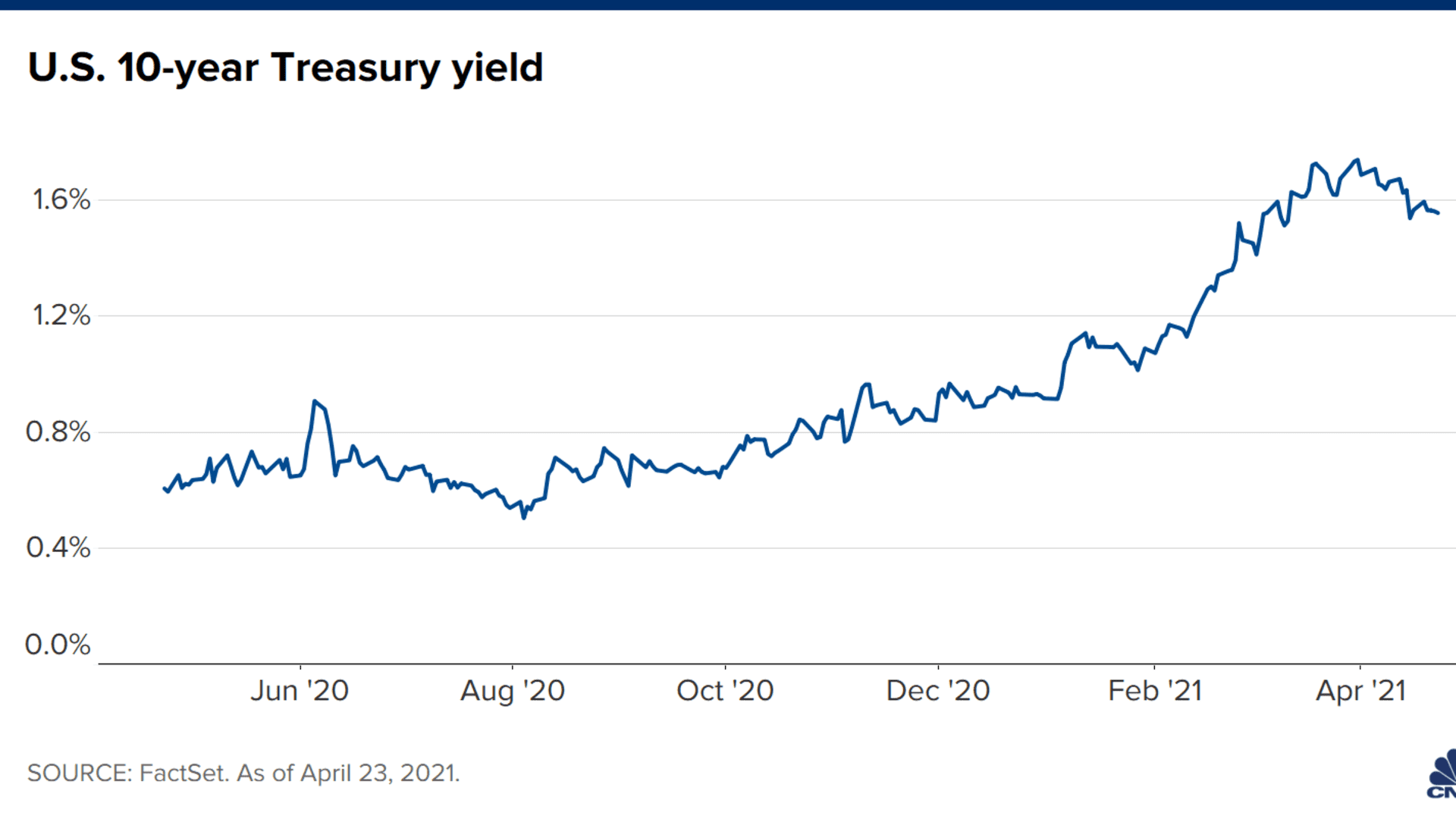
The S&P 500 was down 0.1%, ending the week at 4,180, while Nasdaq Composite was down nearly 0.3% at 14,016. The Dow was off just shy of 0.5% at 34,043.
Tax hike prospects
Stocks were hit hard on Thursday when after a news report said that Biden is expected to propose a capital gains tax rate of 39.6% for people earning more than $1 million a year.
Combined with the 3.8% net investment income tax, the new levy would more than double the long term capital gains rate of 20% or the richest Americans.
Strategists said Biden is expected to propose raising the income tax rate for those earning more than $400,000.

"I think a lot of people are starting to price in the risk there going to be a significant increase in both corporate and capital gains taxes," said Lyngen.
So far, companies have not provided much in the way of commentary on the proposed hike in corporate taxes to 28% from 21% but they have been talking about other costs.
David Bianco, chief investment strategist for the Americas at DWS, said he expects larger companies will do better dealing with supply chain constraints than smaller ones. Big Tech is also likely to fare better during the semiconductor shortage than auto makers, which have already announced production shutdowns, he said.
"Next week is tech week. I think we're going to get down on our knees and just be in awe of their business models and their ability to grow at a behemoth scale," Bianco said.
He said he's not in favor of Wall Street's popular trade into cyclicals and out of growth. He still favors growth.
"We're overweight equities really because we're concerned about rising interest rates," Bianco said. "I'm not bullish in that I expect the market to rise that much from here."
"We stuck with growth and dug deeper into bond substitutes, utilities, staples, real estate," he said, adding he is underweight industrials, energy and materials. "Energy is doomed. It's being nationalized via regulation. I do like industrials, they are well-run companies, but I do think infrastructure spending expectations for classic infrastructure are too high."
He also said industrials are good businesses, but the stocks have become overvalued.
Bianco said he likes big box stores, but smaller retailers are facing big challenges that were already impacting them prior to Covid. He also finds small biotech firms attractive.
"I like healthcare stocks. Those valuations are reasonable. People have been paranoid about politicians beating on them since 1992. They manage through it and lately they've been delivering," he said.
Week ahead calendar
Monday
Earnings: Tesla, Canadian National Railway, Canon, Check Point Software, Otis Worldwide, Vale, Ameriprise, NXP Semiconductor, Albertsons, Royal Phillips
8:30 a.m. Durable goods
Tuesday
FOMC begins two day meeting
Earnings: Microsoft, Alphabet, Visa, Amgen, Advanced Micro Devices, 3M, General Electric, Eli Lilly, Hasbro, United Parcel Service, BP, Novartis, JetBlue, Pultegroup, Archer Daniels Midland, Waste Management, Starbucks, Texas Instrument, Chubb, Mondelez, FireEye, Corning, Raytheon
9:00 a.m. S&P/Case-Shiller
9:00 a.m. FHFA home prices
10:00 a.m. Consumer confidence
10:00 a.m. Housing vacancies
Wednesday
Earnings: Apple, Boeing, Facebook, Qualcomm, Ford, MGM Resorts, Humana, Norfolk Southern, General Dynamics, Boston Scientific, eBay, Samsung Electronics, GlaxoSmithKline, Yum Brands, SiriusXM, Aflac, Cheesecake Factory, Community Health System, CIT Group, Entergy, CME Group, Hess, Ryder System
8:30 a.m. Advance economic indicators
2:00 p.m. Fed statement
2:30 p.m. Fed Chairman Jerome Powell briefing
Thursday
Earnings: Amazon, Caterpillar, McDonald's, Twitter, Bristol-Myers Squibb, Comcast, Merck, Northrop Grumman, Airbus, Kraft Heinz, Intercontinental Exchange, Mastercard, Gilead Sciences, U.S. Steel, Cirrus Logic, Texas Roadhouse, Cabot Oil, PG&E, Royal Dutch Shell, Church & Dwight, Carlyle Group, Southern Co.
8:30 a.m. Initial jobless claims
8:30 a.m. Real GDP Q1
10:00 a.m. Pending home sales
Friday
Earnings: ExxonMobil, Chevron, Colgate-Palmolive, AstraZeneca, Clorox, Barclays, AbbVie, BNP Paribas, Weyerhaeuser, Illinois Tool Works, CBOE Global Markets, Lazard, Newell Brands, Aon, LyondellBasell, Pitney Bowes, Phillips 66, Charter Communications
8:30 a.m. Personal income and spending
8:30 a.m. Employment cost index Q1
9:45 a.m. Chicago PMI
10:00 a.m. Consumer sentiment
Saturday
Earnings: Berkshire Hathaway